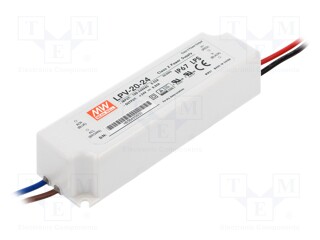
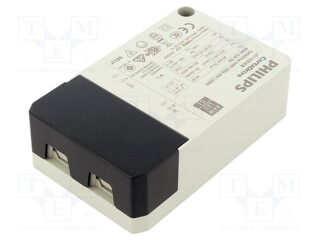
LED Power Supplies
(3 721)LEDs quickly became the most popular light source in almost every application – from households, through industry, to public spaces . This was due to their energy efficiency, a wide choice of different colours and formats, and miniaturization . Therefore, they fit into the needs of diverse projects and are an excellent alternative in the era of renewable energy sources .
LEDs, in contrast to the "classic" illumination methods, require specific power conditions. Their brightness does not change linearly in relation to the applied voltage, they cannot be directly connected to the power grid , and are relatively sensitive to current overloads, so they are easily damaged. Therefore, dedicated power suppliesare an integral part of the lighting system based on light-emitting diodes – a wide range of which can be found in the TME offer. The choice of the right product will depend on several factors, not only the maximum power that the installation will consume. On the other hand, technicians are given a choice: they can use AC and DC energy sources (e.g. batteries), choose products equipped with a number of protections and control systems: dimmers or programmable LEDs controllers whose colour is adjustable .
So let's take a look at the basic parameters and functionalities of LED power supplies. To avoid choosing a product solely based on price and nominal power – two features that are important but can also prove misleading .
How to choose a LED power supply?
Most of the LED power supplies we encounter on the market are pulse LEDs. This allows you to obtain optimal operating parameters – relatively low energy consumption and high efficiency – as well as reduce the size of the product. Unfortunately, in the case of cheaper products coming from untested sources, such a principle of operation may be associated with causing interference in the power supply network (e.g., buzzing of radio receivers or disturbance of Wi-Fi operation).
The most important division of power supplies is the distinction between constant current and constant voltage variants. The choice of the right solution will depend on the light sources we intend to use and how they are connected. In the case of series circuits consisting of elements with similar characteristics (usually high-power LEDs), a constant current power supply should be used – it will automatically raise the voltage at the output until the current in the circuit is of a set value (adjustable and adapted to the given consumers).
If the installation uses elements that are connected in parallel (most often it will be LED strip), one should choose constant voltage power supplies (i.e. maintaining the constant potential difference between the output terminals, regardless of the current that flows in the circuit).
In each of these cases , the maximum power consumed should be taken into account - it should not exceed the nominal power of the driver itself (i.e., the power supply). Since energy consumption is also influenced by other factors (e.g., resistance of wires), it is always worth installing devices with a power of at least 50% higher than it results from a simple summation of parameters. In this way, we will ensure the possibility of expanding the system – but we will also increase the safety of users because the power supply will not overheat. This will also reduce the risk of failure.
Of course, one should take into account not only the power but also the intensity and voltage that will be required by the powered components . The power supplies can provide strictly defined ranges of these parameters, always indicated on the packaging and the nameplate. Exceeding this characteristic will result in failure or activation of the built-in protective elements (cutting off the energy supply to the entire system). It should also be remembered that some power supplies, especially high-power ones, will not work properly if used with elements with too low energy consumption (voltages and output currents have their minimum values specified in the characteristics).
What happens if we connect the wrong power supply to the LED lights?
If we connect the constant voltage power supply to consumers requiring constant current , there are two options. (1) The nominal voltage will turn out to be too low to supply the components of the circuit in question, i.e. each LED module will have a current lower than required; the components will simply not light up (although the driver will work and consume energy). (2) The current obtained by applying the nominal voltage will exceed the values tolerated by the LEDs – they will be immediately and permanently damaged .
Similarly, if we connect several parallel circuits with e.g. several LED strips to the outputs of the constant current power supply – the current will be divided between the circuits and is likely to be too low to supply them properly (flickering of the lights, their uneven operation, etc. may occur).
The probability of randomly selecting the optimal power supply for a given application is negligible and it is not worth taking such a risk.
Important characteristics and parameters of LED power supplies.
In addition to the above tips on selecting an LED power supply for an installation, several other parameters of these devices need to be considered when choosing one.
The size is important not only because of the space in which the device will be installed. The led driver gets hot and therefore should not closely fill the cavity in which it will be placed. Nevertheless, power supplies are often adapted to a very wide range of operating temperatures, as some of them can be installed not only indoors, but also outdoors. Many of the products offered by TME are IP65 and even IP67 rated, which means that they are fully resistant to dust, but also moisture, splashes, and even water jets (e.g., precipitation).
LED power supplies are manufactured for various installations, not only mains ones. Therefore, it should be noted what input voltage a given model requires : it can be, for example, an industrial power supply adapted to the installation of 12V or 24V DC. Such a model will also allow to optimize the operation of installations based on batteries and renewable energy sources. In the latter case, the buyers can also be guided by the efficiency of the power supply - a value expressed as a percentage and giving an estimated idea of the energy dissipated by the driver.
An important feature, which has already been mentioned, is the power, which in most cases ranges from 1W to 1kW – the purchase of a properly selected device will not only reduce the installation costs to the necessary minimum but also save energy and space .
Additional functions of LED power supplies
One of the greatest advantages of using LEDs in lighting systems is the ability to control them easily. When choosing a product for a particular application, it is worth considering the needs of users. Selected drivers have built-in light dimming support – which improves their usability and eliminates the need to complicate the system. Some power supply models can be remotely controlled (Smart Home product segment) or transmit commands to programmable LED modules (e.g., using DALI or DMX interfaces). In this way, it is possible to dim and brighten the light and create complex arrangements.
One more property that is specified in the product characteristics deserves special attention - the flicker free feature. It means that the power supply will not cause an invisible but tiring strobe effect (often noticed when taking pictures or filming - it is also noticeable for some domestic and farm animals).
Warehouse: