Automotive Fuses
(2 592)At the start, it should be noted that automotive fuses are not only intended for road vehicles – they are also used in boats and in other devices, even industrial ones because they are a cheap, comfortable and easily accessible alternative for other safety solutions.
Types and markings of automotive fuses
In modern cars, or at least in the vast majority of cars made in the last decade, different types of fuses are used. They have standardised sizes and markings, thanks to which car users do not have to worry about the availability of those elements. An exception here would be vintage cars, especially those made in European countries, where different types of safety devices were applied.
Old types of automotive fuses – cylindrical, ceramic, continental (torpedo)
The name “cylindrical fuse” may be confusing, because most of the time it refers to fuses used in household appliances or audio/video devices, made in the shape of a cylinder. However, for the past few years, an obligatory safety standard in the automotive industry (especially in continental Europe) was that cylinders had to be ceramic or plastic, with a longitudinally placed strip of cut or twisted metal. Very often, they were called continental or torpedo fuses. The nominal current of those components depended on the width of the conductor. These types of fuses are still available, however, now they mainly come from the military stock or a few specialised retailers.
Typical automotive fuses – blade, flat, lamellar
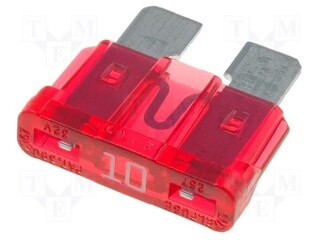
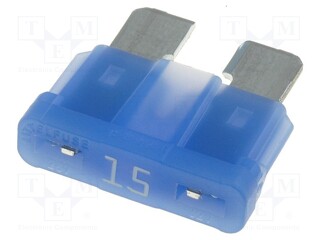
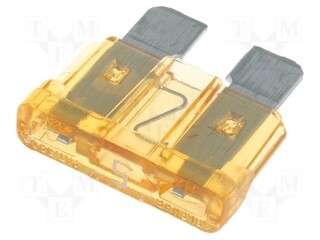
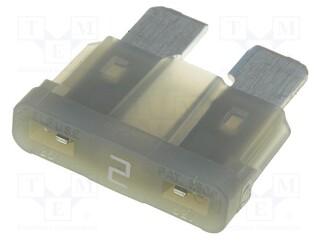
The phrase “automotive fuse” generally refers to blade fuses, made in compliance with the ISO8820 standard (and the American J1284 standard). They are designed in such a way that makes it possible to fit densely arranged safeguards in a small space, for comfortable operation and replacement. At TME, you can also find fuse holders, thanks to which these components can be used in private projects or switchboards in industrial installations.
High-current circuits that, for example, power the starter or spark plugs are protected using components of a different shape – flat fuses with ring terminals on opposite ends of the body. In order to minimise the resistance, they are installed with the use of screw terminals (usually M5 or M8). This type of fuse is called MEGA fuse because of its very high rated currents, which reach hundreds of amps. This value can be read very quickly as it is imprinted on the surface of the component.
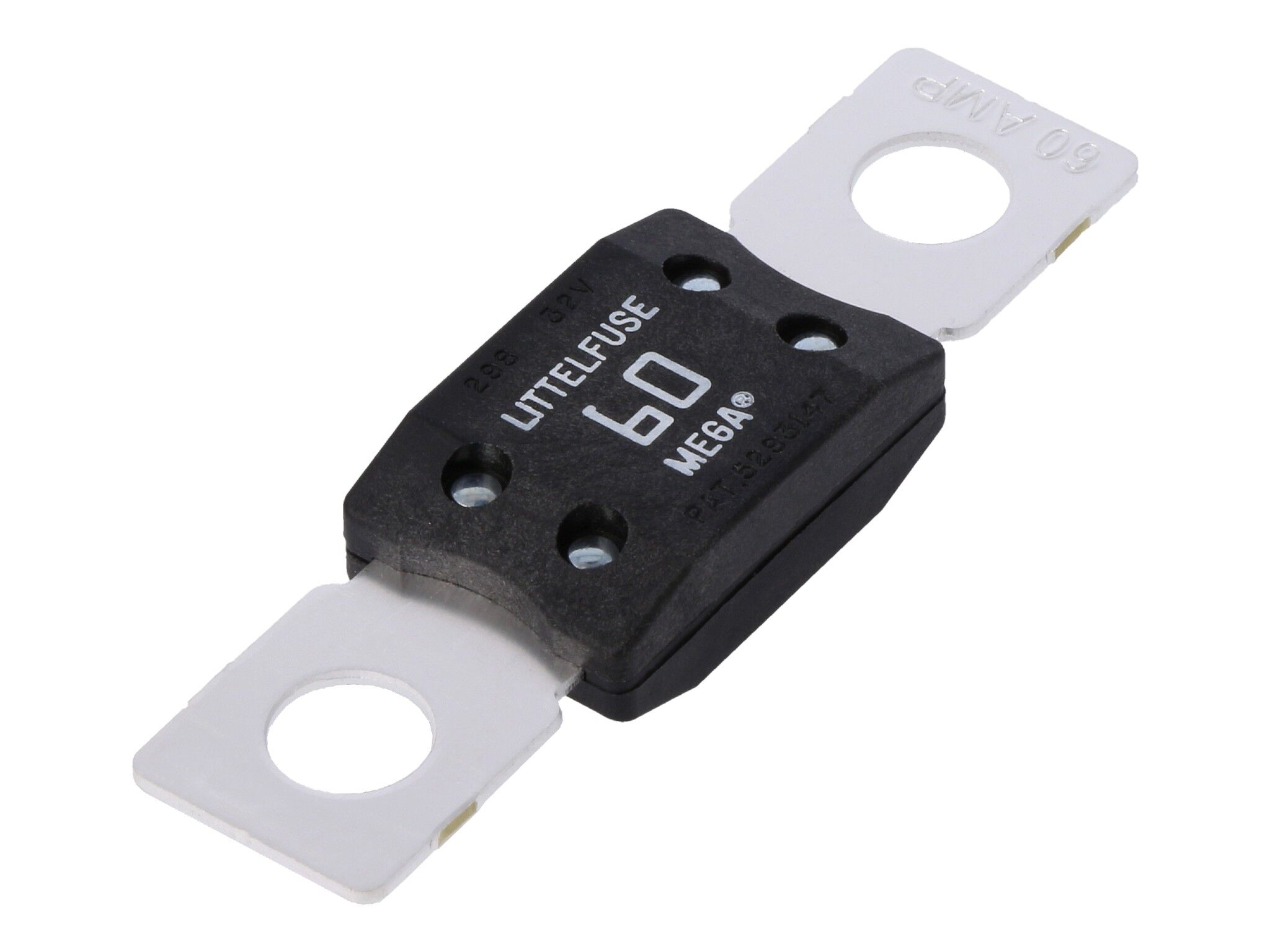 High-current MEGA fuse, often installed near the battery clamps.
Sizes and types of automotive fuses
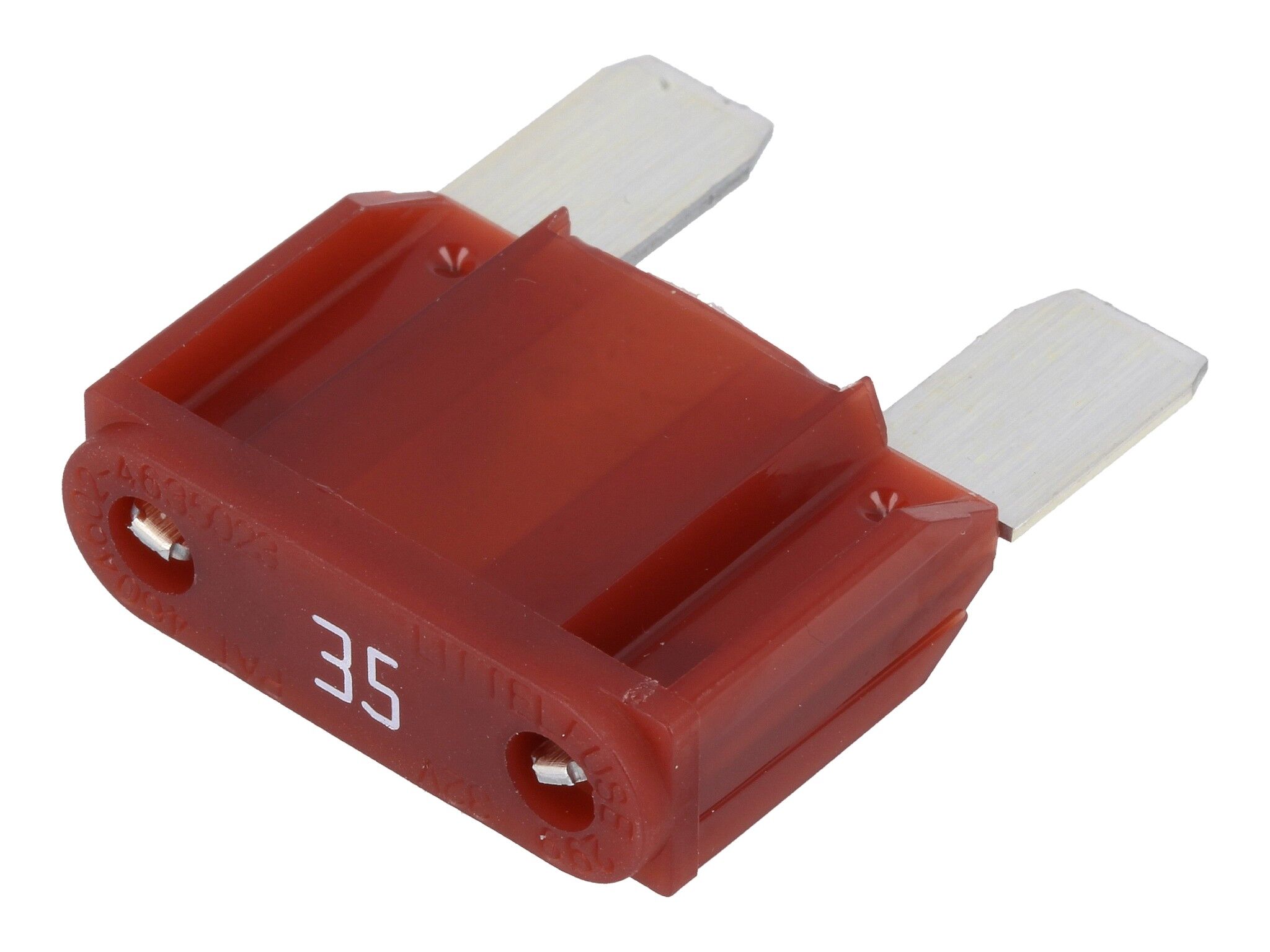
Generally, three types of fuses are used in the automotive industry: standard (“normal”), mini and maxi. Now and again, we can also see three-letter symbols ATM, ATO, APX, etc. They differ in terms of size and (in the case of the largest ones) a colour code denoting their parameters. Sometimes, we can also find Micro2 and Micro3 formats. In the table below, the differences between various types of fuses are presented:
| Type of fuse | Other names | Width | Height |
|---|---|---|---|
| Micro2 | N/A | ca. 9.1mm | ca. 3.8mm |
| Micro3 | N/A | ca. 14.4mm | ca. 4.2mm |
| Mini | APM, ATM | ca. 10.9mm | ca. 3.6mm |
| Standard/Normal | APR, ATC, ATO, ATS | ca. 19.1mm | ca. 5.1mm |
| Maxi | APX | ca. 29.2mm | ca. 8.5mm |

Ratings and colours of automotive fuses
The rating of a fuse, i.e. its rated current, determines the maximum amperage of electricity that the component can conduct without burning out. After exceeding it, the temperature of the fusible wire causes it to break, which in turn, opens the circuit. This type of protection is primarily used for protecting the electrical system. The lead-acid batteries used in cars could deliver very high currents, but if a short-circuit occurs in the circuit connected to it, the wire insulation could melt, the electromechanical components, connectors or sockets/holders could get damaged permanently or a fire could start. That is why a damaged fuse should be replaced with a new component with appropriate parameters.
Automotive fuses are marked in two ways. Often, their rated current is shown on the upper part of the body (visible after embedding the element in the holder). Fuses can also be identified thanks to their colour. In the table below, a commonly used colour coding scheme is presented. It is worth noticing that in the case of Maxi fuses, most of the colours have a much higher current rating than in the case of the smaller elements.
| Current rating depending on size | |||
|---|---|---|---|
| Fuse colour | Mini ca. 11mm | Standard ca. 19mm | Maxi ca. 30mm |
| grey | 2A | 2A | * |
| purple | 3A | 3A | 100A |
| beige/light brown | 5A | 5A | * |
| dark brown | 7.5A | 7.5A | * |
| red | 10A | 10A | 50A |
| blue | 15A | 15A | 60A |
| yellow | 20A | 20A | 70A |
| white/transparent | 25A | 25A | 80A |
| green | 30A | 30A | 30A |
| orange | 40A | 40A | 40A |
* this size is not available in this colour
How to check, choose and replace an automotive fuse?
Checking and replacing automotive fuses are very easy tasks, but drivers and those who do not feel competent enough in the field of electrotechnics might worry that they would not be able to do this. However, this is only an illusion – we will look at the procedure of replacing a fuse step-by-step and go through the prism of frequently asked questions.
For safety reasons, please remember that all the activities described here should be performed after turning off the car (removing the key from the ignition).
Where to find the fuse box in your car?
First of all, fuses are usually found not in one, but in two places in cars (especially modern ones). The exact location of fuse boxes is, of course, described in the car manual, however, sometimes we may not have access to the book. Then, it is worth turning to web browsers; type in the exact model and version of the car in the search bar (the location of electrical components may be dependent on the car variant, most often defined by the manufacture year, engine capacity, and sometimes the trim level).
We can also search for fuses ourselves. In most cases, they can be found under the hood of the car, in a marked plastic case, behind a removable cap placed in the panel in front of the driver’s seat (sometimes, we will only be able to access it after opening the door), or even near the glove compartment on the passenger’s side. High-current fuses, for example those for the starter, can be found directly on the battery terminal. On the inside of the fuse box door, we will find an imprint or sticker with a diagram explaining the rated values of each fuse and, very often, also information about which circuit is protected by which fuse (fuel pump, dipped beam headlights, etc.). In the case of a radio player malfunction, it is good to start by checking the fuse placed on its back wall, right next to the power connector.
Using a multimeter to check automotive fuses
It is possible to check fuses without a multimeter, using an alternative method of testing fuses that will be described below. However, if we have a measuring instrument, the test will run more smoothly. It is only necessary to switch the multimeter to the continuity test mode and then use the probes to touch the test points, which are placed on the top wall of the fuse. The points are directly connected to the leads of the component: if the circuit remains open (the multimeter does not make a high-pitched sound signalling a connection), we can assume that the fuse has blown.
If our multimeter does not test continuity, we can switch it to the ohmmeter mode (Ω). In this case, after applying the probes to the terminals of a working fuse, the displayed value will be near zero. A blown fuse will show infinite resistance (most often signalled by displaying the letter “i”, for infinite).
 Test points on the top edge of the fuse.
Checking automotive fuses without a multimeter
If we do not have access to a multimeter, we can check the fuse using another reliable method, namely visual inspection. Unfortunately, it is only possible in the case of elements made from translucent materials (or with a transparent front panel) and it requires taking the fuse out of the holder. After taking out the fuse we suspect might be blown, we should check if the visible path inside has been disconnected or darkened (which means that the component probably needs to be replaced).
How to replace an automotive fuse?
If we want to embed a blade fuse in a fuse holder, we need to push it in. The spring contacts of the holder clamp on the leads of the element quite strongly, to ensure rigid connection even in the presence of vibrations. To take the fuse out, we need to use a tool: a dedicated handle (extractor, puller) or tongs. In the case of the latter, we need to remember that the body of the element has been made of plastic, which means we need to avoid rushing and grasping the tool too strongly. A new fuse can be installed without using additional instruments, we just need to place the element in the fuse holder. If the contact surface is contaminated or corroded (it has lost its metallic shine), it will be necessary to refresh it using a wire brush, a piece of fine-grain sandpaper or an antioxidant product (depending on the degree of contamination). In that moment, we might find out that it is the dirt or degradation of the contacts that cause the failures of the electrical system. Still, we should replace the fuse – thanks to that, we will be sure that the fuse works according to its rated parameters. The polarity of the protective component does not matter, which means that connecting the fuse “the other way around” mistakenly will not affect its work.
Warehouse: