Miniature energy sources – everything about button batteries
Miniature energy sources – everything about button batteriesDate of publication: 05-12-2025 🕒 12 min read
Small, round, and at first glance inconspicuous – button batteries have been an integral part of our daily lives for years. They power watches, remote controls, hearing aids, and computers, and increasingly, smart sensors and IoT devices as well. In this article, we explain what these miniature energy sources are and how they work, their types and markings, and how to choose the right replacement.
Key information in brief:
- Button batteries are small cells with various chemistries, used in small devices for everyday use.
- Markings on batteries indicate the type of chemistry and their dimensions.
- When choosing a replacement, attention must be paid not only to size but also to the type of chemistry.
- Proper use includes correct identification of poles, avoiding improper "stacking" of cells, and storing in a dry and cool place, away from metal.
- The most serious hazard associated with button batteries is accidental ingestion by children, which can lead to severe injuries or even death.
- Used button batteries should be taken to collection points for recycling and material recovery.
- Modern technologies are moving toward mercury- and cadmium-free cells and better recycling systems, which will reduce the negative environmental impact of button batteries.
Construction and principle of operation of button batteries
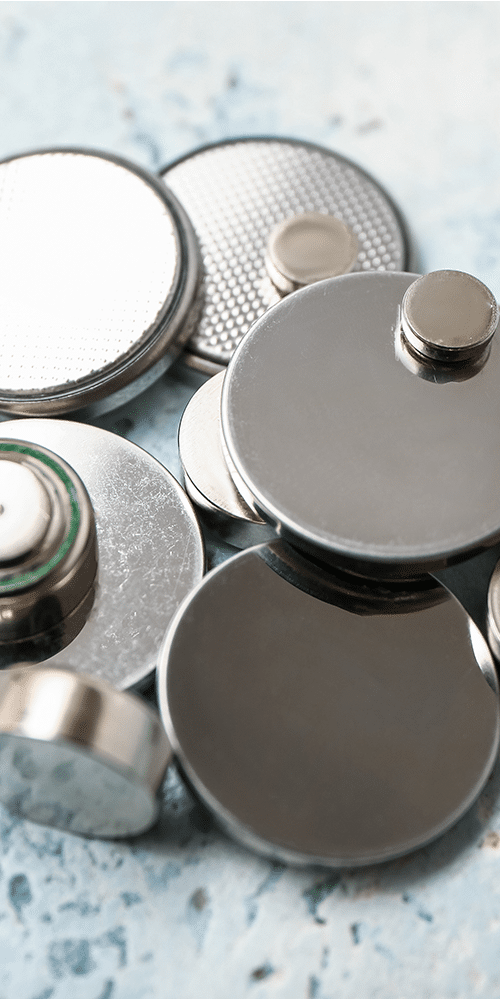
Button batteries are characterized by a very simple yet well-thought-out design. They have the shape of a flattened cylinder with a diameter ranging from a few to several millimeters and a height usually below 6 mm. This allows them to easily fit into devices where space is very limited.
Their basic structure consists of a stainless steel metal casing, which simultaneously serves as the positive terminal (from the bottom) and negative terminal (from the top). Inside, electrodes and electrolyte responsible for chemical reactions producing direct current are placed.
Regardless of the chemistry used, each button battery contains a cathode (positive electrode), anode (negative electrode), and electrolyte, which together form a galvanic cell. Chemical energy stored in active materials is converted during redox reactions into electrical energy, providing a constant voltage needed to power devices.
Types of button batteries
Division of button batteries according to chemistry
Button batteries come in many variants, and their parameters and applications mainly result from the type of chemistry used. The most common types are:
- Alkaline (LR) – widely available and cheap, used in simple devices with low power consumption.
- Lithium (CR) – characterized by high energy density, they perform well in devices requiring stable power for a long time.
- Silver oxide (SR) – offer stable voltage and longer lifespan, thus popular in watches and measuring equipment.
- Zinc-air (Zinc-Air) – activated only after removing the seal, characterized by large capacity and primarily used in hearing aids.
- Button rechargeable batteries (ML, LIR) – rechargeable versions used where frequent replacement or recharging of the energy source is required.
Comparative table of chemical properties
| Battery type | Nominal voltage | Typical capacity | Most common applications |
|---|---|---|---|
| Alkaline (LR) | 1.5V | 50–150mAh | Watches, toys, remote controls |
| Lithium (CR) | 3.0V | 150–240mAh | Car remotes, BIOS, portable devices |
| Silver oxide (SR) | 1.55V | 100–200mAh | Watches, medical equipment, calculators |
| Zinc-air | 1.4V | 100–600mAh | Hearing aids, medical devices |
| Rechargeables (ML, LIR) | 3.0–3.6V | 20–120mAh | Electronic equipment with charging function |


What does a button battery symbol mean?
Markings used on button batteries are standardized according to international IEC norms and allow easy identification of the cell type and dimensions. This helps users easily find the appropriate replacement for a used battery.
The most common notation consists of letters and four digits.
The first letters of the battery symbol denote the chemistry used. For example, CR for lithium batteries, LR for alkaline, SR for silver oxide, and (rarely nowadays) AG in older markings for alkaline batteries.
The four digits indicate dimensions in millimeters. The first two are the diameter, and the next two the height given in tenths of a millimeter. For example, the symbol CR2032 means a lithium battery with a diameter of 20 mm and a height of 3.2 mm.
Replacements and compatibility between manufacturers
Many button batteries have different commercial markings, even though in practice they have identical dimensions and electrical parameters. For example, the popular LR44 battery may also be found under symbols AG13, A76, or 357. Differences in naming arise from systems used by manufacturers, but the cells themselves are usually interchangeable.
However, it is important to remember that a replacement should not only have the same dimensions but also the appropriate chemistry and voltage. Using a battery with a different electrochemical composition may cause:
- shorter device operating time,
- improper functioning (e.g., voltage drops in measuring equipment),
- risk of electronic damage in case of higher voltage.
For these reasons, it is best to follow the full manufacturer's marking and compatibility tables when selecting a replacement. In case of doubts, always check the device manual. This helps avoid situations where a new battery works shorter than the original or causes device problems.
Typical applications of button batteries
Despite their small size, button batteries play an extremely important role in many areas of daily life. Due to their construction and varied chemistry, they are used both in simple home devices and in advanced electronic or medical systems. Below, we present the most common areas where these miniature energy sources are used.

Consumer electronics
Button batteries have been a basic energy source for many small everyday devices for years. Thanks to their small size and relatively stable voltage, they are used in wristwatches, calculators, remote controls for RTV devices, and electronic toys. They provide long-lasting operation at low power consumption, making them an ideal solution for devices used occasionally or in standby mode.
Small medical devices
In medicine, button batteries are particularly important because they power equipment that improves patients’ comfort and often affects the user’s health. They are widely used in hearing aids, blood pressure monitors, glucometers, and other small diagnostic devices. Voltage stability and long operating time are key here, which is why silver oxide and zinc-air cells, which ensure reliability in daily use, are most often used.
Buy button batteries for hearing aid
Computers and settings retention systems
One characteristic application of button batteries is maintaining BIOS settings in desktop and laptop computers. The popular CR2032 model powers the system clock and settings memory even when the computer is fully disconnected from the grid. This prevents losing the date, time, or saved device configuration.

IoT and modern technologies
The dynamic development of the Internet of Things has increased the demand for small and efficient energy sources. Button batteries power smart fitness bands, environmental sensors, as well as embedded electronics in smartphones and other portable devices. Lithium cells, combining compact dimensions with high energy density and long operating time, are most commonly used in this area.
How to properly use button batteries
Proper installation, storage, and awareness of the limitations of these batteries not only prolong their lifespan but also increase the safety of device use.
When replacing a button battery, it is crucial to pay attention to terminal markings. The flat top side of the casing has a "+" sign indicating the positive terminal. The negative terminal is on the opposite side, usually in the form of a metal base.
To correctly place the battery in the device, follow the diagram or markings inside the socket. Incorrect insertion results in power failure and in some cases even electronic damage.
It is also worth knowing what so-called stacking is. This is placing several button batteries one on top of another so their voltages add up. This solution is used in some device designs but only when the manufacturer has foreseen it.
WARNING! Connecting batteries in a stack without proper safeguards can be dangerous and lead to overheating of cells or their leakage.
Safety of button battery use
Safety in the use of button batteries is as important as their proper installation or selection. Although the cells seem harmless due to their small size, precisely for this reason they can pose a serious health hazard. Proper handling of these cells, as well as knowledge of potential dangers, helps avoid risky situations.
Hazards related to battery ingestion
Button batteries, due to their shape and small size, can easily be swallowed, e.g., by children or pets. Their shiny surface makes them resemble a small toy part or candy, increasing the risk of dangerous contact.
Swallowing such a battery is particularly dangerous because when in contact with the moist environment of the digestive tract, chemical reactions occur. Within several dozen minutes, it can cause mucosal burns in the esophagus, leading to serious injuries. Symptoms may include difficulty swallowing, excessive salivation, coughing, sore throat or chest pain, and in severe cases bleeding and vomiting. Even if symptoms are mild, internal damage can progress, posing a threat to health and even life.
To reduce this risk, manufacturers use additional safeguards in the form of special flaps in devices, difficult for children to open, and packaging protecting against accidental access. Many countries, including the United States, have introduced legal regulations such as Reese’s Law.
Reese’s law and European regulations
Reese’s Law is a U.S. legal regulation adopted in 2022 in response to the growing number of accidents involving ingestion of button batteries by children. The law’s name comes from a little girl, Reese Hamsmith, who died after swallowing a lithium battery. Her story became the impulse to introduce stricter safety requirements for such cells.
The law requires manufacturers to implement solutions that minimize the risk of accidental battery ingestion. Requirements include:
- designing devices so battery compartments are secured against easy opening by children
- using packaging difficult to accidentally tear, marked with appropriate warnings
- placing clear information on labels and instructions indicating ingestion hazards
This law also imposes the obligation to implement safety standards defined by the U.S. Consumer Product Safety Commission. This applies not only to batteries themselves but also to all devices containing them – from TV remotes to electronic toys.
Although the regulation was passed in the United States, its provisions have a global impact as many electronics manufacturers adapt product lines to U.S. market requirements.
In the European Union, battery safety is primarily regulated by Directive 2006/66/EC and its subsequent updates, as well as a battery regulation adopted in 2023. The main aim of these legal acts is user safety and environmental protection, but they indirectly also cover children's safety issues. Manufacturers are obligated to:
- implement safe device designs that hinder children’s access to batteries
- use markings compliant with IEC 60086-4 standards warning of ingestion risk
- provide packaging and instructions containing clear hazard messages
The difference between regulations lies in detail and emphasis. Reese’s Law is mainly focused on preventing ingestion, while EU law covers more broadly environmental aspects and the battery lifecycle, including recycling and limiting heavy metals use.
Improper battery storage – risk of short circuit and fire
Besides health hazards related to ingestion, button batteries can also be a source of technical risk. A short circuit occurs when a cell comes into contact with another metal object, for example a key, coin, or piece of jewelry. In such a case, current flow causes battery heating, which can lead to casing damage, electrolyte leakage, and in extreme cases ignition.
To avoid danger, batteries should be stored in original packaging or special insulating containers. When transporting, ensure cells do not touch other conductive objects. This practically eliminates the risk of accidental short circuit.
Proper storage conditions are also very important for button battery lifespan. They should be kept in a dry and cool place, away from direct sunlight or heat sources. High temperatures accelerate self-discharge, and excessive humidity promotes casing corrosion, which can cause leakage.

Any battery showing signs of damage should be replaced as soon as possible. Signs qualifying the cell for disposal include noticeable swelling of the casing, corrosion traces, leakage, or excessive heating during operation. Such batteries pose a serious hazard, so they must not be reused or stored among healthy cells.
Disposal and environmental impact
How to properly dispose of button batteries
Used button batteries should not be thrown into mixed waste because they contain chemicals that can seep into soil and groundwater. Throwing them into regular trash increases the risk of environmental contamination and loss of valuable raw materials.
The safest solution is to take them to special collection points. Many stores, offices, and educational institutions run campaigns to collect used cells. They are then sent to recycling plants where metals such as silver, zinc, or lithium are recovered. This process reduces the demand for new raw materials, benefiting both the economy and the environment.
Eco-friendly alternatives and the future of technology
In recent years, manufacturers increasingly abandon the use of mercury and cadmium in button batteries. These toxic elements were previously used in some technologies but have been practically eliminated within international regulations due to health and environmental threats.
The future of button batteries involves further development of environmentally friendly solutions. Work is ongoing on cells using more stable and less harmful materials, as well as technologies facilitating their recycling. Growing ecological awareness and implementation of modern collection and recovery systems mean that in coming years the environmental impact of button batteries should systematically decrease.
Despite their small size, button batteries play a huge role in everyday electronics – from watches and remotes, through medical devices, to advanced IoT systems. Knowledge of their types, markings, and proper usage principles helps select the right cell for a given application, prolong its life, and increase safety. It is also important to remember proper disposal to protect the environment and enable recovery of valuable materials. Thanks to increasing user awareness plus new regulations and technologies, button batteries are becoming safer and more eco-friendly.
FAQ – Frequently Asked Questions About Button Batteries
Which battery is most commonly used in watches?
The most commonly used batteries in watches are silver-oxide cells (SR), which provide stable voltage and long lifespan. Popular models include SR626SW and SR621SW, often found in quartz watches. Cheaper watches may also use alkaline equivalents (LR), although their operating time is shorter.
Can button batteries leak?
Yes, button batteries can leak, especially when worn out, damaged, or stored improperly. Alkaline cells are most prone to leakage, as they may release electrolyte over time, causing contact corrosion. Modern lithium and silver-oxide versions are much more resistant to leaks, but they still require proper handling and timely replacement.
What is the lifespan of button batteries?
The lifespan of button batteries depends on the type and application. In simple devices such as calculators or kitchen scales, they can last 2–5 years (depending on usage frequency), while in devices with higher power consumption they typically last from several months up to one year.
Are 357 batteries the same as LR44?
357 and LR44 batteries have the same dimensions, but they differ in chemistry. The 357 is a silver-oxide (SR) version, offering more stable voltage and longer lifespan, while LR44 is an alkaline version—cheaper but less durable.
Can I replace an LR44 battery with a 357 or AG13?
Yes, they can be used interchangeably because they share the same dimensions. The 357 is the better choice, as the silver-oxide chemistry provides longer and more stable operation. AG13 and LR44 are alkaline versions, which are more affordable but discharge more quickly.
Why is there a CR2032 battery in my computer?
The CR2032 battery in a computer powers the real-time clock (RTC) and BIOS/UEFI settings memory, ensuring that the date, time, and system configuration do not reset when the device is unplugged from power.
How long does a CR2032 battery last in a computer?
A CR2032 battery in a computer typically lasts between 3 and 5 years, and sometimes even longer under favorable conditions, before it needs to be replaced.
What is the difference between a button cell and a coin cell battery?
A button cell is a type of coin battery with a small, flat shape, mainly used in compact devices. The term “coin battery” is broader and refers to any power source made of one or more galvanic cells, regardless of shape or size. In other words, every button cell is a coin battery, but not every coin battery has a “button” shape.
Can button batteries be recharged?
Most button batteries are single-use cells and are not suitable for recharging. However, special versions labeled ML or LIR are rechargeable button batteries and can be safely recharged using an appropriate charger.
Why are button batteries still used?
Button batteries are still used because they offer small size, low weight, and long life at low power consumption. This makes them ideal for watches, remotes, medical devices, and sensors, where larger power sources would not be practical.
Can a CR2025 battery be replaced with a CR2032?
Yes, a CR2025 can be replaced with a CR2032 because both have the same diameter and a voltage of 3 V. However, they differ in thickness—the CR2032 is 0.7 mm thicker and has a higher capacity, so you must check whether it fits in the device’s battery compartment.
Which button batteries are most commonly used?
The most commonly used button batteries are CR2032 in computers and electronics, LR44/AG13 in toys and small devices, and SR626SW in watches. Zinc-air cells are also popular, especially in hearing aids.
How can I check whether a button battery is rechargeable?
A button battery is rechargeable only if its marking includes symbols such as ML, LIR, or another designation indicating a rechargeable version. Standard batteries marked CR, LR, or SR are single-use and must not be recharged.
Transfer Multisort Elektronik (TME) is one of the world’s largest global distributors of electronic components, electrotechnical parts, workshop equipment, and industrial automation. The catalog includes over 1,500,000 products from 1,300 leading manufacturers. TME’s modern logistics centers in Łódź and Rzgów (Poland), with a combined area of over 40,000 m², ship nearly 6,000 packages daily to customers in more than 150 countries.
TME also invests in the development of knowledge and skills of young engineers and electronics enthusiasts through the TME Education project, and supports the tech community by organizing the TechMasterEvent series, promoting innovation and experience exchange.