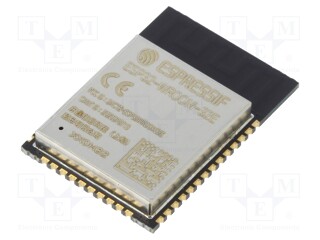
IoT (WiFi/Bluetooth) modules; Kind of network:WiFi
(127)By definition, IoT devices (Internet of Things) are electronic circuits with communication functionalities. In the vast majority of cases, they use wireless data transmission, mostly based on worldwide standards such as Wi-Fi or Bluetooth. To implement such solutions in a trouble-free manner, ready-made circuits are applied in almost all cases. This is because their design requires extensive testing and a specific architecture Thus, using a communication module designed by a specialist manufacturer is simply the most cost-effective and efficient solution. See below for an overview of characteristics and assortment of such modules.
Communication module selection and types
Communication modules can be mainly divided according to the standards they support or according to their programming capabilities. The former is obvious – it is related to the technologies a given product is compatible with. The latter is related to the module design. As stable and secure data transmission requires relatively high computing power, numerous systems come with microcontrollers or systems on a chip (SoC) (System on Chip) that can operate independently or even control the entire circuit operation. In such cases, a communication module becomes the platform on the basis of which the entire device is designed. This translates into simpler, streamlined prototyping and construction phases, accelerated production and, more often than not, reduced costs.
Key communication module features
While selecting a module for a given application, first you need to select a communication method that is best suited to the needs of the actual project – in the case of IoT devices in consumer and industrial electronics, the most common considerations include applicable Bluetooth and Wi-Fi standards. However, note that these technologies are not homogeneous.
Bluetooth standards
Bluetooth is a wireless communication technology operating within open ISM frequencies ( industrial, scientific, and medical). Successive versions of Bluetooth (2.0, 3.0, up to the 5.x iterations currently under development) have incorporated functionalities that are required by an ever-growing range of devices – initially, these included small computer and mobile phone accessories (mice, headsets), but over time it has become possible to design more extensive communication systems and ensure faster data transfers, collaboration of more devices and support for networks with the mesh topology (moreover, the maximum range has been extended, periphery detection features have been improved and communication safety has been enhanced). Perhaps the most important change observed for the last ten years has been the increase in the Bluetooth Low Energy protocol popularity (supported by versions 4.0 and later).
The Bluetooth Low Energy (Bluetooth BLE) protocol uses simpler modulation and, as its name suggests, has been developed to design energy-efficient, primarily battery-powered, devices. Its specification defines several profiles dedicated to specific device types (GPS satnav devices, blood pressure and weight monitors, HID, i.e. Human Interface Device etc.). In practice GATT is the most commonly used profile, Generic Attribute Profile, and it is based on the tree of services (services) and their attributes. The profile defines clear methods for reading and modifying values placed in attributes. They function similarly to processor registers, as they simply operate a device (changing settings, exchanging data, etc.).
Wi-Fi versions
Wi-Fi belongs to the set of IEEE 802.11 standards and defines wireless network protocols in terms of their physical layer and the data connection sub-layer. In practice, this means that successive versions of Wi-Fi specify key aspects of communication processes, i.e. the frequencies, number and width of transmission channels, maximum speed, etc. Successive versions of Wi-Fi are designated with letters specifying a relevant IEEE standard: Wi-Fi 1 is designated by letter “b”, 2 – “a”, 3 – “g”, 4 – “n”, 5 – “ac” and 6 – “ax”. The versions are backward compatible, and communication takes place within 2.4 GHz and 5 GHz bands.
As Wi-Fi is used to connect devices to the Internet, or at least a local network, communication modules supporting this protocol provide designers with fast data transmission and extensive adaptability options. The selection of the application layer to be used (HTTP, FTP, SSH, TLS/SSL etc.) depends exclusively on the module control software.
Encryption and safety
As wireless communications can be monitored by unauthorised parties, transmitted data should be secured. The information encryption methods (mostly AES) are based on complex mathematical operations. Their high-level software-based operation would be inefficient (e.g. it would consume a significant amount of the computing power of a microcontroller controlling a device), so circuits whose sole purpose is to encrypt and decrypt information are implemented in communication modules. It improves the security level (as the encryption keys are handled in hardware and are invisible to software) and ensures faster communication (necessary calculations are performed by circuits designed specifically for this purpose).
Interface
Communication modules use various serial interfaces to ensure trouble-free communication with a control unit. Here, most common standards used in electronic devices (I2C, SPI etc.) are applied. For microcontroller-based products that can operate in a stand-alone mode (to control the entire device operation), such as the popular ESP32 series, the specification details not only the protocols used to control the module, but also other input/output ports supported by a given circuit. They may include, e.g. USB buses, GPIO interfaces or even A/C converters. Similarly, the characteristics of modules for handling sound transmissions include the C/A converter output (to an audio amplifier) or the I2S port.
Antennas and antenna outputs
The majority of modules comes with integrated antennas in a form of SMD elements or traces printed on PCBs. Communication within 2.4/5 GHz frequencies allows the use of compact radiators. Nevertheless, designers often go for internal antennas. It may be caused by the necessity to increase the module range or may result from design-related considerations. For example, an IoT sensor for field work may be enclosed in a housing that shields electromagnetic waves, in which case the design should take into account the option of leading the antenna outside of the device body.
Other relevant characteristics
Specifications also include other key information regarding the performance of each communication module. Primarily, they describe certain basic characteristics (power supply, size, thermal tolerance, mounting methods, housing), but other data should also be kept in mind when selecting a module. These include for instance the transmitter power and receiver sensitivity (specified in dBm, which is a logarithmic scale describing power ratings in mW), as well as transmission speed (which usually does not coincide with the maximum speed indicated in a given standard). When considering the use of stand-alone modules equipped with programmable microcontrollers, one should pay attention to the architecture of a given system and the capacity of the on-board RAM and Flash memory, because, in the case of more complex devices, such as those aggregating significant amounts of data, these parameters may significantly limit the design capabilities. Finally, a very important parameter for communication modules in some applications is their current consumption. It is significant in the case of battery-powered circuits or circuits supplied with power obtained from renewable sources (e.g. PV cells). This characteristic is usually specified in the TX/RX format, i.e. by compiling the current values required for data transmission and reception, respectively. The latter value will obviously be lower, but one should remember that, in practice, the Bluetooth and Wi-Fi communication is always bi-directional.
Kind of networkWiFi
Warehouse: