Anemometers – applications and design
Anemometers – applications and designDate of publication: 12-04-2024 Update date: 28-01-2025 🕒 10 min read
Briefly speaking, anemometers are instruments designed to measure air flow speed and wind power. They are commonly used in meteorology, installation and servicing operations, as well as numerous other fields where weather conditions and gas flow need to be monitored.
- Anemometers: types and principles of operation
- Additional features and characteristics
- Pitot and Prandtl tubes
- Anemometers and the Beaufort scale
- Applications of anemometers
- How to choose a suitable anemometer
Key types of anemometers – overview
Anemometers are used in many fields of application, for example to monitor and get an understanding of weather conditions, which is of great importance in the context of various human activities. They support us in such areas as improving flight safety or controlling ventilation systems, as well as in the field of wind-based green energy generation.
Anemometers can be roughly divided into several types, each with its own specific applications. The most commonly used anemometer types include:
- Rotor anemometers, whose design includes a rotor rotated by the wind power, and its rotational speed is proportional to the wind speed, which makes it possible to make measurements. The rotor is usually located perpendicularly to the wind blowing direction, which ensures most precise wind speed readouts. It is worth remembering that such instruments can be somewhat prone to measurement errors under changing wind direction conditions or when obstacles are present in the vicinity of the rotor. This means that their precision is impacted by numerous factors, including the instrument design, wind characteristics, environmental conditions, and objects located around the measurement point.
- Directional anemometers can be used not only to determine the wind speed, but also its direction, as their rotor rotates not only around its axis, but also within the vertical plane. The direction meter can be designed as an additional rotor or a flag mounted on a rotating platform, but this functionality can also be achieved by placing the basic rotor on a rotating plane (a solution often implemented, for example, in chimney cowls supporting building ventilation system operation).
- Ultrasonic anemometers use the principle of ultrasonic wave propagation in the wind. Such anemometers measure the wind speed on the basis of the time required by an ultrasonic wave to travel through the space between the transmitter and the receiver located at a certain distance. The entire operating principle of ultrasonic anemometers consists in the fact that at least two ultrasonic wave transmitters and receivers are used. One set consists of the transmitter and the receiver, and it is set up in the direction opposite to the wind flow, while the other one is set up in the direction aligned with the wind flow. When the instrument is activated, two signals are sent – one in the direction opposite to the wind flow and the other in line with the air movement direction. The anemometer measures the travel duration for both signals between the corresponding transmitters and receivers, as this value is not identical. If the wind is blowing in the direction of the wave, the signal travel time is reduced, whereas if the wind is blowing in the opposite direction, the signal takes a little longer to travel the same distance between the transmitter and the receiver. Then, this difference is used by the anemometer to calculate the actual wind speed.
Such anemometers are relatively precise, but the measurement accuracy can be slightly affected by such environmental conditions as air temperature and humidity. Nevertheless, they bring certain benefits, such as lack of movable mechanical parts (less wear and tear and fewer malfunctions) and lower maintenance costs. - Thermo-anemometers (hot-wire anemometers) operate basing on the temperature difference between sensors placed on a fixed and movable base. The latter are subjected to wind power, which results in their cooling. The measured temperature difference between the two sensors is converted into the wind speed using a suitable algorithm.
- A Doppler anemometer (radar anemometer) employs the Doppler effect to measure the speed of particles moving in a gas or gas mixture, such as the air. It is most commonly used in meteorology, in particular to measure wind speed in the atmosphere. Its operation is based on the Doppler effect, which refers to the change in the frequency of a wave emitted by a source when both the source and the observer move in relation to each other. In Doppler anemometers, an electromagnetic (usually radar) wave is sent towards airborne particles (aerosols, water droplets, etc.). It is then reflected off these particles and returns to the detector. The wave return speed varies in relation to the particle speed, which corresponds proportionally to the instantaneous wind speed and allows it to be determined. The entire measurement process includes a few stages:
- sending a wave: a Doppler anemometer transmits an electromagnetic wave (most often in the radio wave or microwave range) towards the area in which the wind speed is measured;
- wave reflection: an electromagnetic wave is reflected by particles suspended in a gas, which are moved by the wind;
- frequency change: if particles move at a certain speed in line with or against the wave direction, they change the reflected wave frequency (Doppler effect);
- frequency change detection: an anemometer measures the change in the frequency of the wave reflected from particles, which is proportional to their radial velocity;
- wind speed calculation: based on the frequency change, it calculates the radial velocity of the particles, from which the wind speed in the area is directly derived.Doppler anemometers are used in meteorology and atmospheric research (wind-related research at higher altitudes, air traffic control, etc.). They provide data regarding both wind speed and its direction. Unlike traditional anemometers, Doppler anemometers can operate over long distances and, under certain weather conditions, are more precise than other anemometer types.
- A deflecting vane anemometer is a simple and popular anemometer type used to measure the wind speed. It consists of flat vanes mounted on a circular arm. These vanes are set at a certain angle in relation to the wind direction, which triggers their rotational movement.
Basic operation principles of deflecting vane anemometers:
- vanes: an anemometer comes with three or more flat vanes mounted on a circular arm. They are set at a certain angle in relation to the wind, which angle is usually selected in a manner ensuring the necessary sensitivity to wind speed differences;
- rotational movement: when affected by the wind, the flat vanes are raised and start rotating around the arm axis;
- speed measurement: the vane rotational speed is proportional to the wind speed, thanks to which the users can measure and determine the wind speed in a given location.
Deflecting vane anemometers are relatively cheap and easy to use, which makes them a popular instrument used in broadly-defined field conditions. However, they do have some limitations, such as lower precision compared to more advanced anemometers and quite a narrow application field, as they determine the wind speed, but not its direction.
Most common additional features and characteristics of state-of-the-art anemometers
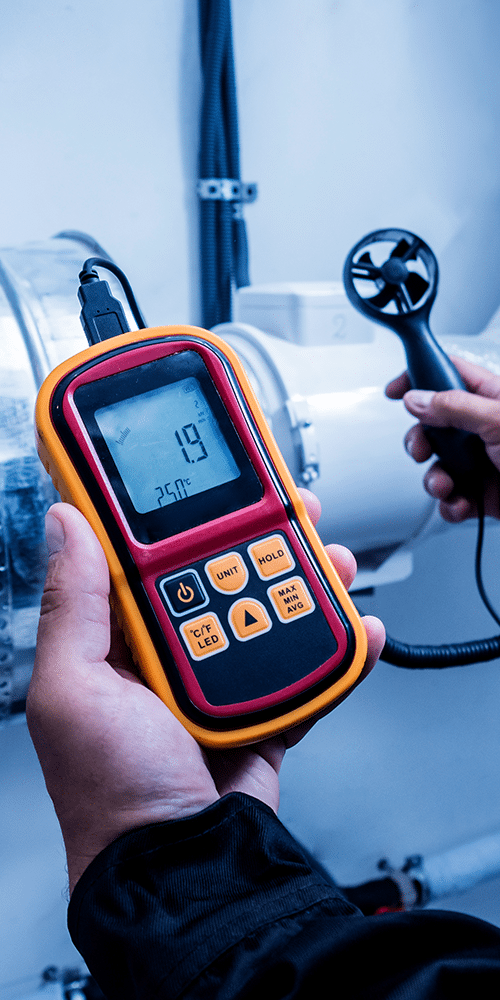
State-of-the-art anemometers are technically advanced instruments based on digital computational systems. They offer a number of functionalities, most importantly including accurate wind speed measurements in various conditions. The measurement results can be displayed in various units, such as knots, kilometres per hour or metres per second. They also come with several additional features, the most important of which are described below.
- Wind direction measurement: some anemometers come with an integrated compass or sensor to detect the actual wind direction. This feature is particularly useful in the field of meteorology, navigation or air traffic control.
- Average speed determination: modern anemometers may calculate the average wind speed during a certain period of time, which may come in handy while conducting scientific research or monitoring weather conditions.
- Data and statistic storage: some cutting-edge anemometers come with a data-logging feature to record measurement results over a specified time interval and even extract basic statistical parameters (mean, median, trends). This feature is particularly useful for long-term measurements and monitoring activities, for example while conducting scientific research.
- Wireless connection and data transmission: modern anemometers more and more often come with the wireless data transmission function, which enables them to remotely monitor wind speeds or send data to other devices, such as PCs with analytic software installed.
- Additional functionalities: depending on the model, anemometers can be equipped with diverse additional functionalities, such as backlit LCD displays, threshold alarms, precise temperature measurements, temperature compensation, built-in GPS modules or hygrometers for humidity measurements. See below for more details regarding these functionalities.
- Windchill function: simply speaking, this feature determines the instrument ability to calculate the parameter determining how the wind speed affects the perceived air temperature. Its operation is based on the phenomenon in which the temperature perceived by a person is lower than the actual air temperature. The “windchill” effect can also be described as “real-feel” temperature, which is seemingly a very subjective parameter. However, this only seems so, as anemometers measuring temperature use information about the measured wind speed, and this data (temperature and wind speed) is actually very much objective. The method of calculating the windchill parameter value is also important, as these instruments use correct algorithms for this purpose, i.e. mathematical formulas developed as a result of cooperation of numerous research centres conducting long-term research regarding wind impact on the human body. While only two decades ago there were just two or three standardised formulas for the whole world, today different formulas are used depending on the region and locally accepted meteorological standards, all because the windchill parameter is particularly important in terms of the safety and health of athletes participating in numerous sports events. High wind speeds at low temperatures can increase the risk of frostbite and hypothermia, which can have significant impact on the health and safety of, for example, ski jumpers or Himalayan climbers. Furthermore, people living in temperate climate zones or simply above the 50th parallel (for the northern as well as the southern hemisphere) have to take the windchill factor into account in their daily activities performed in winter conditions. Therefore, meteorological warnings at these latitudes generally take into account both the objective temperature and the windchill effect, i.e. the temperature subjectively perceived by the human body when exposed to low temperatures and wind.
- Durability and resistance to weather conditions: state-of-the-art anemometers are designed to be durable and resistant to weather conditions, which facilitates their use in diverse environments, from mountainous to offshore areas. Therefore, they are often made of impact-resistant materials or energy-absorbing soft plastic linings. Tightness (IP degree of protection) is also an important factor, as strong winds measured by anemometers are accompanied by rainfall.
The functions and features described above make state-of-the-art anemometers versatile tools used in many diverse fields, such as meteorology or navigation, but also in sports (including ski jumping and many other non-Olympic extreme sports), and in wind farm monitoring.
Pitot and Prandtl tubes – instruments offering a common alternative for anemometers
Firstly, note that neither of these simple devices can replace an anemometer, as each of them takes measurements differently and under different conditions, i.e. one tube measures air (or water) speed, while the other one measures pressure, and these measurements are taken by devices placed on a fast-moving object (aircraft or boat). However, when coupled together, they create a characteristic Pitot-Prandl tube system, ensuring relatively precise wind speed calculations with accuracy comparable to the results obtained by an immobile anemometer.
The operating principle of the Pitot tube, which allows accurate speed measurement, is based on calculating the pressure difference between its two areas. Two openings are made in an L-shaped tube – one of them is directed perpendicularly to the flow (dynamic opening), and the other one is a static opening directed along the air flow. The pressure difference detected between these two areas is proportional to the square of the gas or liquid (air or water) velocity, and this formula facilitates calculating the necessary parameter. The Pitot tube is commonly used in the aviation industry. It is usually placed on an external plane surface, where it is directly exposed to air stream impact during a flight. The pressure difference between the static channel and the dynamic opening of the Pitot tube makes it possible to measure the relative air speed.
The Prandtl tube (static tube) is also used in the field of air navigation and meteorology, as it is designed to measure the static pressure in moving gases, e.g. in the air during the flight. Its principle of operation is based on accepting static pressure from the opening that is perpendicular to the flow, and it is therefore mounted in such a way as to avoid the dynamic pressure impact (caused by air movement) exerted on the static pressure measurement.
Basic fields of Prandtl tube application include static pressure measurements in the aviation industry (a tube is mounted on an external plane surface, for example on its wing or fuselage). This instrument makes it possible to calibrate the dynamic pressure measurements obtained previously using the above-mentioned Pitot tube and atmospheric parameter measurements (meteorology) at various altitudes.
The combined use of both tubes (Pitot-Prandtl tube system) offers much more extensive possibilities. After measuring two parameters – dynamic pressure (Pitot tube) and static pressure (Prandtl tube) – you can calculate other parameters such as air speed and altitude, which have key significance for flight control, navigation or meteorology applications.
Anemometers and the Beaufort scale
Anemometers do not show results in the Beaufort scale, developed in the 19th century by Sir Francis Beaufort (British naval officer), which is a classification system for wind speed and describes its different degrees depending on its effect on the sea, which manifests itself in a very turbulent manner. Anemometers are used to measure wind speed directly, but although they do not themselves assign results to a specific Beaufort scale number, the parameters they measure can later be compared with the corresponding forces of the Beaufort scale in order to determine what effect a wind of a given speed would have on the surroundings (i.e. on the sea water). Note also that numerous modern anemometers provide results in units such as knots, kilometres per hour or metres per second, which actually makes it easier to later relate them to the Beaufort scale as required.
Anemometers – common applications
Anemometers are widely used in numerous fields of application, some of which have been discusses above.
- Meteorology: anemometers are key instruments used in meteorology. They are used to monitor wind speed and direction, i.e. the factors that are crucial to understanding and forecasting atmospheric conditions. Such data is used to elaborate weather forecasts, analyse climate patterns, and examine climate changes in various scales.
- Security and industry: in some cases, anemometers are used in industrial applications, particularly in sectors where wind speed can affect occupational safety, such as in the construction industry or on offshore oil rigs. These instruments are also commonly used to control ventilation and air-conditioning systems in industrial facilities, warehouses or office blocks.
- Scientific research: anemometers are widely used in various scientific research fields such as atmospheric physics, environmental engineering, geophysics and aerodynamic engineering. They help conduct studies related to air movement, dynamic atmospheric processes and wind impact exerted on various buildings and structures.
- Wind power engineering: in the wind energy generation industry, anemometers are used to measure wind speeds in areas where new wind farms are planned to be built. Such measurements are used to assess the energy potential of a given area, the optimum layout of wind turbines, and the subsequent location monitoring. Anemometers are also used for recuperative system measurements.
- Aviation: here, anemometers are used to measure wind speeds at airports, but they are also helpful in monitoring atmospheric conditions to ensure aircraft take-off and touch-down safety.
- Oceanography: anemometers help monitor wind speeds over seas and oceans. Such data is vital for marine navigation purposes and also gives better understanding of the marine climate patters.
- Extreme sports: in windsurfing, sailing, skiing or paragliding, anemometers are used to measure wind speeds to help athletes adapt their activities to the actual weather conditions.
Correct anemometer operation and obtaining precise readouts
In order to obtain accurate readouts, applicable operating procedures must be adhered to, and certain factors affecting measurement precision must be taken into account. There are a few important tips on how to obtain reliable readouts and keep anemometers in good working order. Key factors contributing to readout precision are described below.
- Calibration: regular calibration is a key factor contributing to retaining anemometer’s measurement accuracy. Therefore, it is necessary to regularly verify if the device is calibrated as per manufacturer's recommendations and within the specified intervals.
- Obstacles: readouts can be affected by objects located in the vicinity. Therefore, measurements must be taken in locations without any obstacles that might interfere with the air flow and exert negative impact on readout accuracy.
- Correct installation height: in meteorological or aviation applications, applicable standards specify the installation height of 10 metres above ground or apron level. It prevents interference caused by aboveground obstacles (e.g. local buildings).
- Perpendicular wind measurement: the wind direction may and usually does affect speed measurement results. Therefore, an anemometer should be held (mounted) perpendicularly to the air flow direction. This is particularly important in ventilation systems, where even slight deviations may significantly alter the readouts obtained. Note also that accessories in the form of dedicated flanges are available on the market to improve measurement precision.
- Instrument cleanliness: before each measurement, sensors and the anemometer itself must also be checked for cleanliness. Dirt, splashes and dust, icing and frost can negatively affect the measurement results.
Anemometers offered by TME
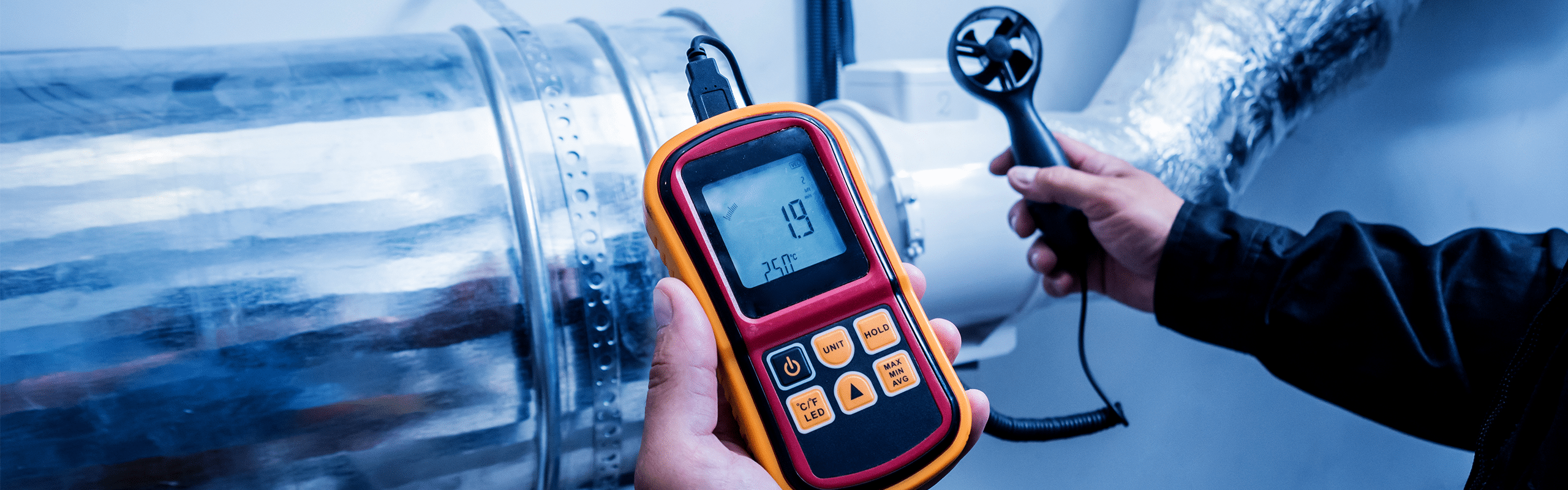
Several dozen of anemometer models, with various degrees of technological complexity, are present in the TME product catalogue. The leading manufacturers of this product range include Extech, Beha-Amprobe, Tenmars, Fluke, Testo and Uni-T. The majority of almost 60 models come with the temperature measurement feature (thermo-anemometers) with the measurement accuracy ranging from 0°C to 70°C. Note also that numerous models come with the feature enabling users to toggle the display units between Celsius and Fahrenheit degrees. Moreover, the typical air speed measurement range for the vast majority of these models is from 0 to 25–32 metres per second. Some of them come with hygrometers to measure air humidity, air pressure and quantitative airflow measurement modules, and most of them can store from 8 to 100 individual measurement results. Most models have a digital LCD display, which come with the backlight feature, exceptionally useful when taking measurements in the evening or at night. Some of them support wired or wireless communication with computers, tablets or smartphones via RS232 or Bluetooth interfaces, or via a USB cable connection. All models are small and handy, as they are powered by disposable or built-in rechargeable batteries.
Transfer Multisort Elektronik (TME) is one of the world’s largest global distributors of electronic components, electrotechnical parts, workshop equipment, and industrial automation. The catalog includes over 1,300,000 products from 1,300 leading manufacturers. TME’s modern logistics centers in Łódź and Rzgów (Poland), with a combined area of over 40,000 m², ship nearly 6,000 packages daily to customers in more than 150 countries.
TME also invests in the development of knowledge and skills of young engineers and electronics enthusiasts through the TME Education project, and supports the tech community by organizing the TechMasterEvent series, promoting innovation and experience exchange.