Industrial RAM modules from GOODRAM
Industrial RAM modules from GOODRAMDate of publication: 18-08-2023 🕒 7 min read
Computerisation of the industry, and the IT industry itself, have become “a sign of the times”. With the exploitation of electronics being more intensive than ever, electronic components have to be designed for constant use and extreme, often suboptimal operating conditions.
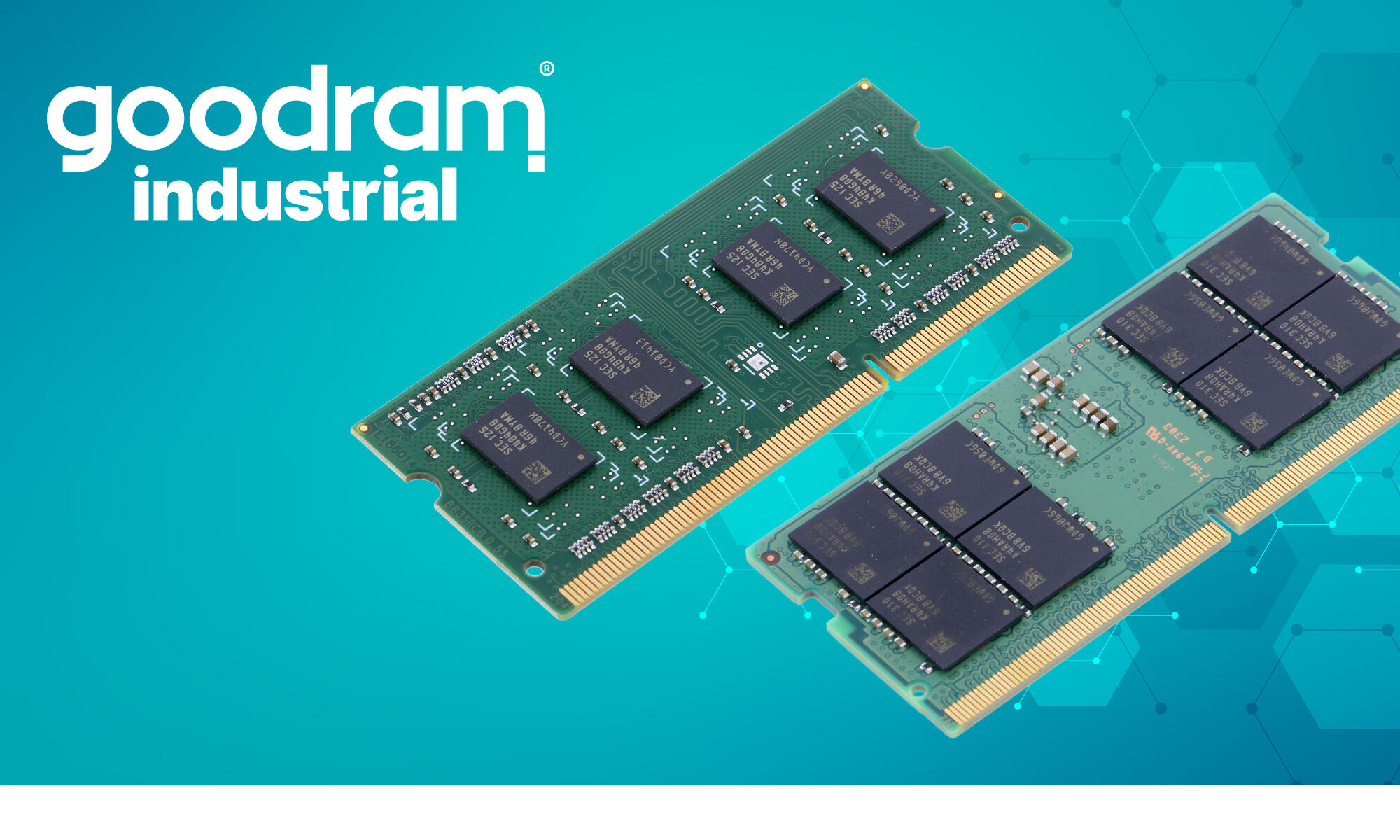
Industrial RAM modules are a brand new category in the TME catalogue. The first to arrive were the products from GOODRAM, a Polish company with 30 years’ experience. As of today, GOODRAM is the only manufacturer of RAM modules in Europe, well-known and trusted by customers from many countries in the EU and beyond.
That being so, we would like to provide our customers with an overview of the products offered by this supplier and present some basic concepts related to RAM modules used in computers, servers, industrial automation drivers and integrated compact systems such as IoT or embedded.
Industrial RAM modules from GOODRAM
In this article, we will touch upon the following subjects:
- Why do computers need RAM?
- SDRAM, SODIMM and other acronyms from the computer world
- How is RAM adapted for industrial applications?
- What are the differences between DDR3, DDR4 and DDR5 memory modules?
A few words about RAM
Random access memory is one of the most important components of a conventional computer, as without it, the device will not boot. The CPU uses it for storing data – therefore, it is directly controlled and accessed by the central processing unit. In newer systems, it can also serve other functions, e.g. be shared with the graphics processing unit (GPU). In other words, the speed and quality of RAM directly affects how the computer functions. What is more, the evolution of such components is linked to the evolution of the CPU architecture, which is why whenever we want to purchase a memory module we have to check if its speed, capacity and version is supported by our CPU model. Such information, being one of the most important details, is always listed in the specifications of the CPU.
Basic acronyms explained
Before we demonstrate how GOODRAM Industrial RAM modules stand out from the components offered by their competitors and other consumer products, we will take a look at a few acronyms used when describing their structure.
RAM
This acronym derives from Random Access Memory. The term describes an electronic circuit in which the CPU can access any random memory cell (bits and bytes) by referring to a specific memory address. Thanks to random access memory, CPUs can manage data and overwrite unnecessary information, etc. Moreover, it makes far-reaching optimisation of computer software possible, mainly with the use of low-level programming languages (such as C).
DRAM
This acronym refers to a type of RAM, or, more specifically, the circuit that is used to make it. The DRAM cell architecture consists of a MOS transistor connected to a capacitor. By charging and discharging the capacitor, the transistor gates are kept at the “high” or “low” logic state. Due to the extremely low capacitance of the capacitor and the leakage current, this type of RAM requires a memory refresh cycle – hence the letter “D” which stands for Dynamic was added to “RAM”. In the case of static random access memory (SRAM), this process is not required, because the structure of SRAM is based on flip-flop circuits, and such memory cells are more expensive to produce.
SDRAM
SDRAM stands for Synchronous Dynamic Random Access Memory. The additional element in the name, Synchronous, refers to the fact that it is synchronised with the system bus. Such memory modules operate according to the commands sent by the CPU through the data bus and clock signal. Thanks to this, task queues can be formed, and data can be transmitted in packets. Such a structure of RAM modules, equipped with their own controller, allowed to increase the memory speed significantly.
DDR
The term “DDR” is usually associated with all the subsequent RAM generations (e.g. DDR3) described below. However, this acronym generally refers to the technology that is commonly used in various electronic buses. The name DDR stands for Double Data Rate, which indicates that data transmission between the communicating circuits occurs both when there is a rising and falling edge in the clock signal. In other words, the bus frequency is doubled.
DIMM
DIMM, Dual In-line Memory Module, is a RAM module form factor. It was standardised by JEDEC, an independent, American electronics engineering council. Currently, most computers utilise this RAM module type – both sides of the RAM PCB are equipped with contacts, thanks to which it is compatible with the 64-bit bus (modules with a single row of contacts could only be used with the 32-bit bus).
SODIMM
SODIMM or SO-DIMM is, literally, a smaller-sized DIMM – the letters “S” and “O” stand for Small Outline. Such modules are intended for compact devices (laptops, routers, industrial computers, etc.), while the DIMM variants mentioned above (mounted on a larger PCB) are used in PCs, servers and other similar devices, where size differences between components do not matter that much.


What makes GOODRAM products stand out?
Industrial conditions require from manufacturers a lot of emphasis on the durability and longevity of their components. Memory modules included in the GOODRAM Industrial series are designed with such applications in mind. A perfect example of this is the wide thermal tolerance displayed by these RAM modules (they can operate in a temperature ranging from 0°C to 85°C) and the high quality of integrated circuits incorporated into their design. In addition, selected products also support the ECC (Error Correction Code) technology which is a method used for detecting and correcting errors in data transmission – this guarantees that the computer will run smoothly without any interruption, even during constant and intensive memory use. It is also important to note that the modules undergo extensive longevity and thermal resistance tests, and are manufactured in a factory located in the European Union.
GOODRAM Industrial RAM modules have been produced and designed for automotive, home and industrial automation applications. They can be also mounted inside self-checkouts and other self-service machines (parcel lockers, ticket machines), IoT devices (Internet of Things) or even medical equipment.
DDR memory generations
As we have mentioned above, the “DDR” acronym is often associated with the subsequent generations of computer RAM modules. In the case of the products from the GOODRAM Industrial offer, there are three types of RAM available: DDR3, DDR4, DDR5. Due to the fact that these versions are not interchangeable, and the technology used to manufacture them is directly linked to their parameters and capabilities, below we present a short description of memory modules you can purchase from the TME catalogue.


DDR3
These RAM modules are still used in some systems, mainly those which are based on reliable motherboards. The products offered by GOODRAM can also be used for performing upgrades and maintenance work on older computers. The DDR3 modules exhibit energy consumption levels that are lower than the ones displayed by their predecessors, which is why they quickly gained popularity and began to be commonly used in mobile devices and compact computers. The industrial DDR3 RAM modules are compatible with buses operating at up to 1600 MHz and offer a choice of the following capacities: 2 GB, 4 GB and 8 GB.
DDR4
As of now, this is the most popular type of RAM. When it was first launched, DDR4 offered a number of innovative solutions: a lower power supply voltage (1.2 V DC), address parity bit and DBI (Data Bus Inversion), i.e. the technology for data bus inversion which was applied in order to reduce the energy consumed by RAM. The DDR4 modules from GOODRAM Industrial can be purchased in capacities ranging from 4 GB to 32 GB and operating at the frequency of up to 3200 MHz, meaning that the speed of data transfer can reach up to 25600 MB/s.
DDR5
This is the newest generation of DRAM. The upgrades, which include the power management integrated circuit, made it possible to achieve an even lower level of energy consumption (reduced by 15% in comparison to the previous solutions). Not only did such a design improve the parameters and stability of data transfer but it also simplified the structure of motherboards. Furthermore, DDR5 utilizes dual 32-bit channels which doubles the efficiency of older RAM modules.
In the TME catalogue, you can find GOODRAM Industrial DIMM and SODIMM memory modules operating at the frequency of 4800 MHz. They offer a choice of the following total capacities: 8 GB, 16 GB and 32 GB.