Three Phase Inverters
(1 360)An inverter is a common name for a frequency inverter. It is used to convert DC voltage into AC voltage of adjustable frequency and, quite often, duty cycle.
Typically, inverters are supplied by AC power, which can lead to some misunderstanding, considering the definition given above. Inside the inverter housing, the input voltage is rectified by means of diodes or a synchronous rectifier. In the past, inverters used thyristors controlled by discrete digital systems. Modern inverters employ signal processors, with MOS or IGBT transistors used in the output stage.
It is worth noting that frequency inverters can be used not only to control the rotational speed of motors, but they can also serve as components of voltage converters. Usually, however, “inverter” or a “frequency inverter” means a device used to control a motor.
How does an inverter work
The voltage frequency in the EU power grid is 50 Hz. A frequency inverter allows the output voltage frequency to be changed between 0 and 50 Hz, which makes it possible to regulate the rotational speed of the asynchronous motor from stop to maximum. More advanced inverters allow for a wider range of adjustments, for example from 0 to 87 Hz, thanks to which higher speed can be achieved than with the mains power.
Types of inverters
The basic division of inverters takes into account the number of input and output voltage phases. The simplest ones have one input and one output phase. They are used to control the rotational speed of 1-phase motors. There are also inverters with 1-phase power supply and 3-phase output. They allow you to control 3-phase motors with 1-phase power supply. In industrial applications, there are usually 3-phase powered inverters with 3-phase output.
Apart from the division which takes into account the number of voltage phases, inverters are also categorised, depending on the power source, into voltage inverters (powered from a voltage source - with a large capacitor at the input) and current inverters (powered from a current source - with a choke at the input).
What are inverters used for
Inverters make it possible to control the operation of AC electric motors. Adjustable torque and rotational speed make it possible to gently accelerate or decelerate the motor, and to adjust its speed and torque to the drive requirements. Thanks to such properties, inverters have a number of applications. They are commonly used to control the capacity of pumps and compressors, the speed of fans, washing machines, centrifuges, mixers. They can also be found in agricultural machines, gate drives (for a smooth closing and opening of gates), belt conveyors, etc.
Classification depending on the control method
A scalar-control inverter may have a linear (V/f = const.) or quadratic (V/f2 = const.) characteristic. Scalar inverters are used in variable torque drive systems. They operate by supplying the motor with a minimum amount of energy so that the output frequency does not fall below the setpoint.
Vector-control inverters (DTC) work well in drives that require constant torque at variable speed. For control purposes, they use the frequency and output waveform adjustment.
Choosing the right inverter for your application
When choosing an inverter for a given application, it is necessary to pay attention not only to the electrical parameters but also to the required functionality of the user interface and the motor control method.
First of all, it is necessary to determine the manner of powering the inverter and motor power. The inverter’s power should be equal to or greater than the motor power. If several motors are controlled by one frequency inverter, the nominal power of all motors should be summed up and about 15...20% safety margin should be added.
Subsequently, the motor control method must be determined. In many applications, an algorithm that is built into the inverter will suffice. For example, if the inverter controls a pump motor with a fixed or regulated capacity, an automatic soft start and speed control with a potentiometer are likely to be enough. On the other hand, if the pump is to be controlled by an HMI panel, PLC or computer, it is necessary to ensure that the inverter features a suitable digital interface.
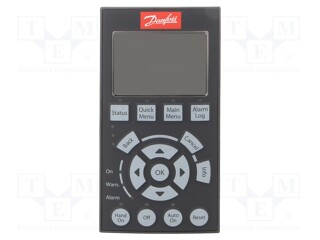
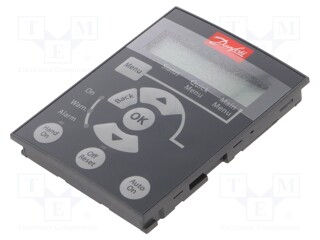
Some high-tech inverters also have status outputs that inform about reaching the pre-set rpm rate, motor or power source failure, etc. Many of them are also fitted with a display for setting and showing operating parameters.
Another important criterion will be how the inverter is mounted in a control cabinet or other place in the target application. Most common inverters are designed for DIN rail mounting, however, this is not a rule.
Technological development has made it possible to reduce the prices of inverters, while improving their power output and functionalities. The price of an inverter is largely dependent on the manufacturer, load power, number of phases, quality of components, type of user interface, built-in protection, etc.
Warehouse: